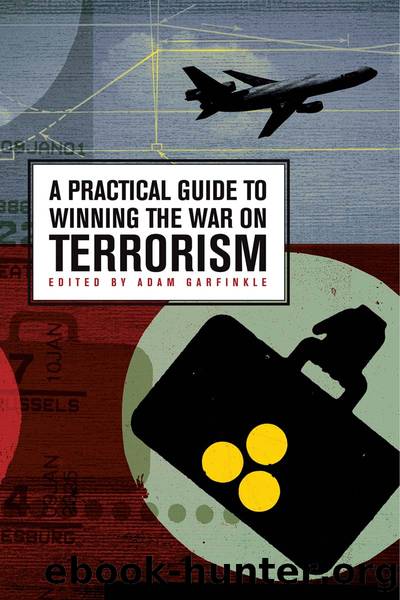
A Practical Guide to Winning the War on Terrorism by Adam Garfinkle
Author:Adam Garfinkle [Garfinkle, Adam]
Language: eng
Format: epub
Tags: Political Science, Terrorism
ISBN: 9780817945435
Google: BwZwBAAAQBAJ
Publisher: Hoover Institution Press
Published: 2013-09-01T12:49:24+00:00
9
With Allies Like This: Pakistan and the War on Terrorism
Stephen Philip Cohen
During his 1999â2000 presidential campaign, George W. Bush could not name the leader of Pakistan. In June 2003, President (and army chief) Pervez Musharraf spent a high-profile day at Camp David, where a multiyear $3 billion American aid package was announced. We learn from this little anecdote that the September 11 attacks on the United States have propelled Pakistan into the limelight of U.S. national security concerns. There it remains today, labeled a âfrontline allyâ in the war on terrorism.1
To some extent, this recent contretemps repeats an old pattern of alliance and estrangement that has characterized U.S.-Pakistan relations since the early 1950s.2 Pakistan was, in turn, an instrument of American policy in containing the Soviets and then the Chinese and then in removing the Soviets from Afghanistan. However, this time there is a difference: Pakistan is a critical ally, but it is also a potential source of terrorism, as well as a declared nuclear weapons state. Some have pointed to Pakistanâs growing social extremism, its use of terror as an instrument of state policy in Kashmir, its continuing meddling in Afghanistan, and evidence of leakage of Pakistani nuclear technology to Iran, North Korea, and perhaps other states. If Pakistan is an ally as far as Afghanistan is concerned, it has not behaved like a friend of the United States in many other respects.
A closer look at Pakistan reveals that radical groups do not enjoy widespread support in the country. Despite recent electoral trends, most middle-class and urban Pakistanis do not subscribe to the radical agenda. They believe Pakistan should be a modern but Islamic stateâwith âIslamicâ being confined to a few spheres of public life.
Nonetheless, Pakistan today finds itself at a critical juncture. Radical Islam has found a home in Pakistan, and the danger of the spread of extremism, though by no means imminent, is greater than it was a decade ago. Pakistan is also one of the worldâs most anti-American countries, which makes Americans especially vulnerable there.3 If its radicalism is left unchecked, Pakistan could indeed evolve into a nuclear-armed terrorist state. Washington must seize the opportunity presented by its current alliance to help move Pakistan in the direction of moderation and stability.
To do this requires a policy of engagement on two parallel tracks. The first is short-term and âcurative,â ensuring that Pakistanâs present terrorist groups are checked by better police, army, and intelligence operations and addressing the specific causes that motivate their acts. The second policy track is âpreventive,â a long-term engagement to revitalize Pakistanâs enfeebled civilian and social institutions. This second track is a daunting but essential task.
Download
This site does not store any files on its server. We only index and link to content provided by other sites. Please contact the content providers to delete copyright contents if any and email us, we'll remove relevant links or contents immediately.
| Arms Control | Diplomacy |
| Security | Trades & Tariffs |
| Treaties | African |
| Asian | Australian & Oceanian |
| Canadian | Caribbean & Latin American |
| European | Middle Eastern |
| Russian & Former Soviet Union |
The Secret History by Donna Tartt(19088)
The Social Justice Warrior Handbook by Lisa De Pasquale(12190)
Thirteen Reasons Why by Jay Asher(8909)
This Is How You Lose Her by Junot Diaz(6886)
Weapons of Math Destruction by Cathy O'Neil(6279)
Zero to One by Peter Thiel(5801)
Beartown by Fredrik Backman(5754)
The Myth of the Strong Leader by Archie Brown(5507)
The Fire Next Time by James Baldwin(5444)
How Democracies Die by Steven Levitsky & Daniel Ziblatt(5218)
Promise Me, Dad by Joe Biden(5153)
Stone's Rules by Roger Stone(5087)
A Higher Loyalty: Truth, Lies, and Leadership by James Comey(4962)
100 Deadly Skills by Clint Emerson(4925)
Rise and Kill First by Ronen Bergman(4788)
Secrecy World by Jake Bernstein(4753)
The David Icke Guide to the Global Conspiracy (and how to end it) by David Icke(4717)
The Farm by Tom Rob Smith(4507)
The Doomsday Machine by Daniel Ellsberg(4490)
